XR Lab
The XR Lab designs and builds immersive applications, from the first question to a working product. It translates the essence of a real situation into VR, with particular expertise in virtual humans and immersive learning.
Learn moreThe Limburg Immersive Technologies Network connects academia, industry, and society to advance XR, VR, and AR research, education, and innovation — making work, learning, and healthcare more effective, inclusive, and sustainable.
The Limburg Immersive Technologies (LIT) Network is a strategic partnership between Maastricht University and Zuyd University of Applied Sciences, officially launched on 6 May 2025.
Through interdisciplinary research, talent development, and industry collaboration, LIT accelerates the adoption of Extended Reality (XR) solutions — including Virtual Reality (VR), Augmented Reality (AR), and Mixed Reality (MR) — that transform how we work, learn, and solve challenges in society.
Rooted in the Limburg region but oriented toward the broader Euregion and international community, LIT aligns with EU goals for inclusive, sustainable technological development and positions Limburg as a digital leader in XR innovation.
Interdisciplinary XR research with real-world impact
Hands-on XR learning bridging theory and practice
Industry testbed for immersive technology solutions
"LIT is a key driver of Limburg's digital transformation through XR. It aligns with broader EU goals for inclusive, sustainable technological development."

LIT brings together labs, research projects, and collaborative initiatives that push the boundaries of immersive technology across healthcare, education, industry, and culture.
The XR Lab designs and builds immersive applications, from the first question to a working product. It translates the essence of a real situation into VR, with particular expertise in virtual humans and immersive learning.
Learn moreThe Digital Experience Lab at Maastricht University is a state-of-the-art research facility exploring how immersive technologies transform education, healthcare, and professional practice. Combining VR, AR, and mixed reality with human-centered design and cutting-edge evaluation methods.
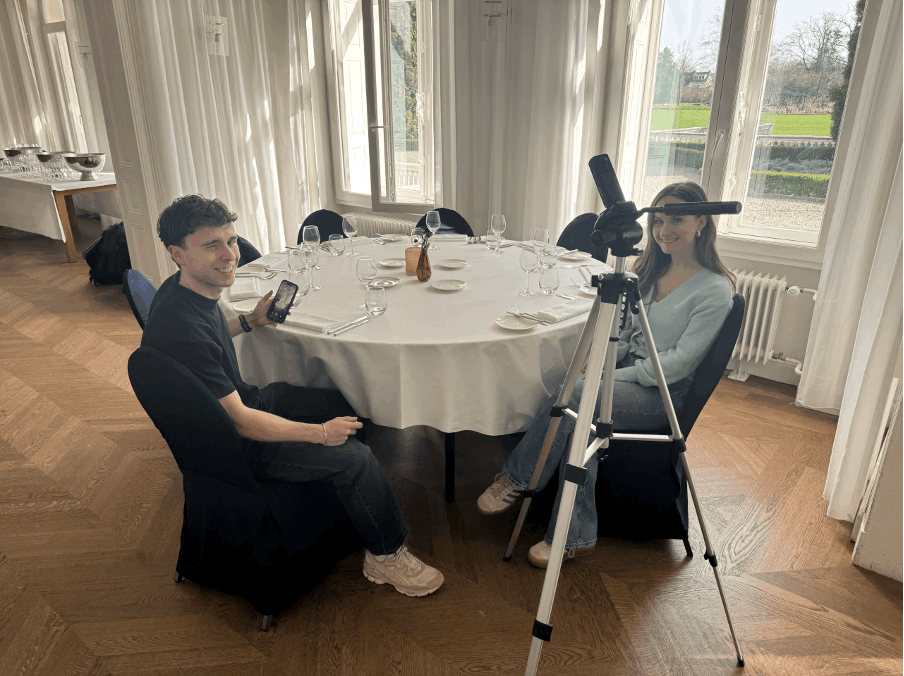
Learn moreAn interdisciplinary space where immersive technology meets food culture and hospitality innovation. Exploring AI-generated virtual environments, 3D food printing, robotics in guest interactions, and physiological measurement devices to redefine the dining and hospitality experience.
Learn moreDeveloping VR and AR applications for medical training, patient rehabilitation, and therapeutic interventions. Collaborative project between Maastricht UMC+ and LIT research partners, producing evidence-based XR tools that improve clinical outcomes and training efficiency.
Learn moreDesigning and deploying XR curricula across Maastricht University and Zuyd programs. Students gain hands-on experience with cutting-edge immersive tools through internships, real-world projects, and collaborative challenges with industry partners — bridging theory and practice.
Learn moreA dedicated co-creation space for regional companies — from SMEs to multinationals — to test and prototype immersive technology solutions. Access top research talent, state-of-the-art XR equipment, and LIT's collaborative R&D methodology in a low-barrier, high-impact environment.
Learn moreZuyd's XR growth framework helps educators and institutions assess and advance their maturity in immersive technology adoption. A structured, practical tool for mapping XR readiness across teaching, infrastructure, and professional development — driving meaningful, step-by-step progress.
Explore the frameworkLIT's flagship annual conference: "Bridging between realities: transformative, inclusive, and sustainable XR." Three days of keynote speeches, practice use cases, co-creation workshops, and networking sessions connecting international researchers, practitioners, and innovators.
Register interestLIT creates meaningful connections and opportunities for a diverse range of stakeholders, each with distinct advantages tailored to their goals.
Enable cross-disciplinary XR research with partners from technology, healthcare, and the arts. Access shared infrastructure, joint funding pathways, and a regional platform for publishing impact-driven results.
Test and develop immersive technology solutions with the support of top academic talent. The LIT testbed provides low-risk, high-impact R&D opportunities for companies of all sizes in the Euregion.
Bridge the gap between academic theory and professional XR practice. LIT connects students and early-career researchers with real-world projects, industry mentors, and hands-on learning in state-of-the-art facilities.
Leverage LIT's evidence-based ecosystem mapping to guide regional innovation policy. LIT positions Limburg as a digital leader in XR and supports the EU's broader agenda for inclusive and sustainable technology development.
LIT is anchored by two world-class universities in the heart of the Euregion, with an expanding network of industry, government, and international academic partners.
One of the youngest universities in the Netherlands and one of the best in the world, Maastricht University is known for its unique, multidisciplinary approach to education and research — and its innovative Problem-Based Learning (PBL) methodology.
Zuyd University of Applied Sciences prepares students for professional practice through practical, hands-on education across campuses in Heerlen, Sittard, and Maastricht. With strong ties to regional industry, Zuyd bridges academia and applied innovation.
XR Groeiraster — Zuyd's XR growth frameworkLIT actively welcomes new collaborators from education, business, healthcare, and government. Together we build a vibrant regional ecosystem for immersive technology innovation.
"Bridging between realities: transformative, inclusive, and sustainable XR"
LIT's flagship event brings together international researchers, practitioners, students, and policymakers for three days of knowledge exchange, co-creation sessions, keynote presentations, and live XR demonstrations.
Confirmed speakers include
Celebrated the official launch at Teaching Hotel Château Bethlehem with 30+ participants. Highlights: opening & vision by Dominik Mahr, Danny Han & Bas Vogelsangs; lightning talks on XR in health, education, and industry; Food Experience Lab & DEXLab tours; World Café co-creation sessions; closing reflections by Prof. dr. Gaby Odekerken-Schröder.
A regular gathering for LIT researchers to share findings, forge collaborations, and explore new directions in immersive technology research.
From launch events and workshops to research projects and conferences — a look at what the LIT Network has been doing across the Euregion.
Tim Hilken and Richard Martina led a DEXLab Masterclass at the Finance Experience Day organised by Fagro | Team EIFFEL — demonstrating how AR/VR can simulate complex financial decision-making and visualise real-time data in 3D environments for professionals.
Introducing the XRM2025 speaker lineup: Max Louwerse (Tilburg/UM, SpaceBuzz), Thijs de Vries (Warp VR), Ruben Hekkens & Thom van de Moosdijk (ASML XRV Lab), and Thomas Kubski & Mathilde Toussaint (Deloitte Digital).
LIT, Maastricht University, and Zuyd host the 10th International XR-Metaverse Conference in Maastricht. Theme: "Bridging between realities: transformative, inclusive, and sustainable XR." Scientific, poster, and industry tracks, plus a special healthcare stream.
The official launch of the LIT Network brought together over 30 researchers, industry leaders, students, and policymakers at Teaching Hotel Château Bethlehem — kicking off with keynotes by Dominik Mahr, Danny Han, and Bas Vogelsangs, XR experience tours, and World Café co-creation sessions.
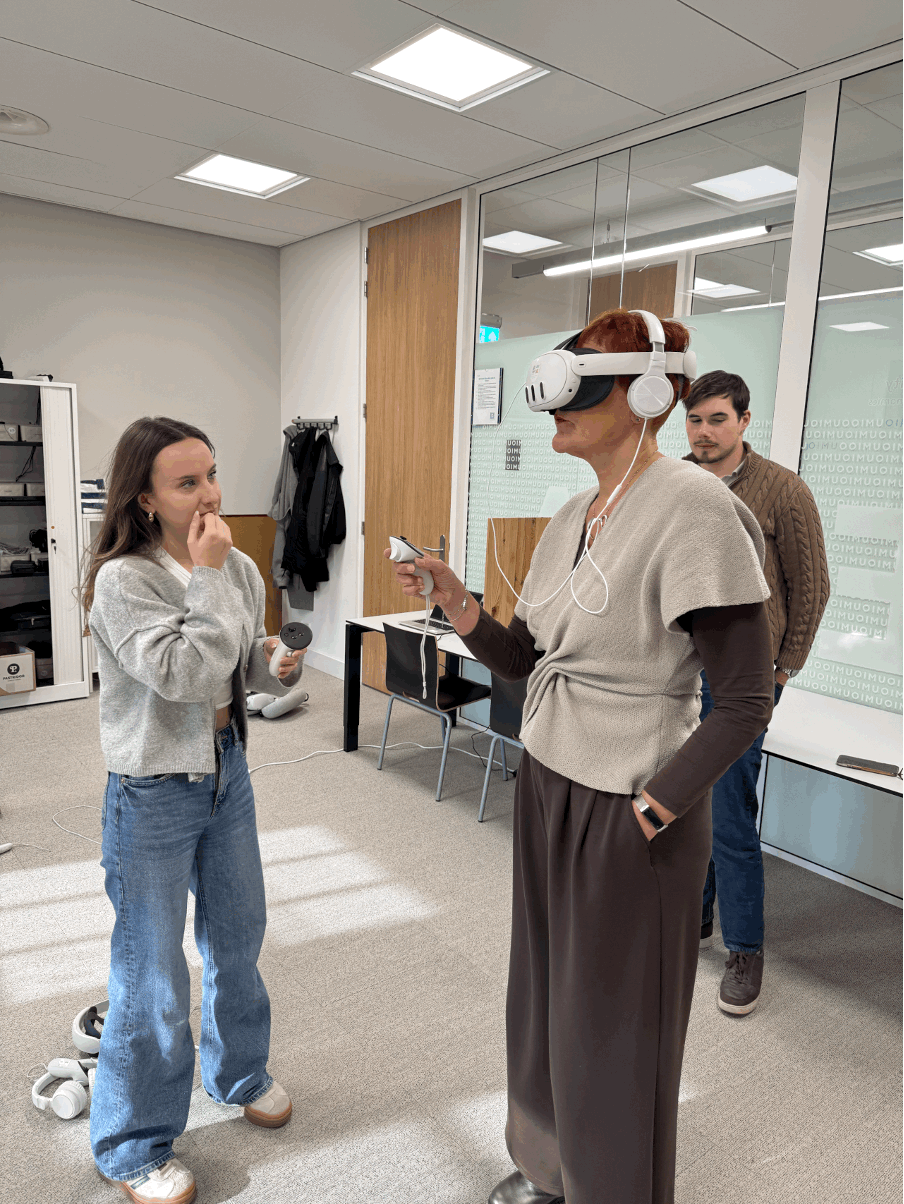
Dominik Mahr and Alexandru Mariș delivered an interactive session at UMIO | Maastricht University, guiding business professionals through hands-on VR and AR experiences using the Meta Quest 3 — including virtual speech experiments, 3D objects in real space, and virtual try-ons.
Students from the Maastricht School of Management visited DEXLab for a hands-on workshop rotating between service robots, AR/VR try-outs, and AI-to-AI interaction scenarios — guided by Jonas Heller and Marc Becker.
Nine teams of Business Engineering students tackled real-world challenges in XR, service robots, and automated logistics — developing business models and ecosystem strategies in a guided innovation sprint led by Prof. Dr. Dominik Mahr.
Services Marketing students visited DEXLab to explore VR scenarios, AI-to-AI conversational systems, and service robots — reflecting on how these tools influence value perception and decision-making in real service environments.
In a joint project by Maastricht Center for Robots, DEXLab, and Hotel Management School Maastricht, a student team built VR scenarios using WarpVR — placing 120 participants in simulated hospitality environments to study how people experience collaboration with service robots.
Services Marketing students at UM, working with DEXLab and LIT, developed AI, VR, and AR service concepts to rethink how young talent connects with companies — using design thinking to tackle career orientation, employer branding, and talent attraction.
Whether you are a researcher, student, company, or policymaker — LIT offers meaningful pathways to collaborate, innovate, and lead in immersive technologies.
A strategic alliance of:
Maastricht University
Zuyd University of Applied Sciences